![]()
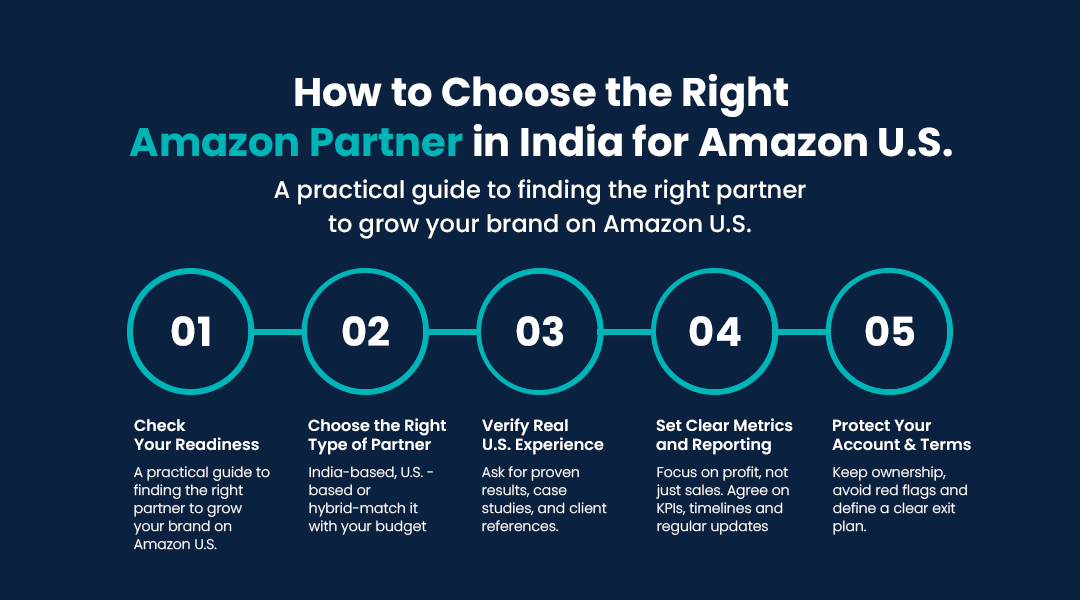
The right Amazon partner in India for Amazon U.S. is one with proven U.S. marketplace results, clear profit targets, and respect for your ownership of the account.
Here is a risk few agency pitches mention: you can double your sales on Amazon U.S. and still lose money.
Many Indian brands pick a partner by comparing service lists and monthly fees. That misses the real question: can this partner grow profit in a market where shoppers, competitors, and costs differ from Amazon India?
This guide shows you how to check your readiness, test a partner’s real experience, compare costs fairly, and protect your account.
Is your brand ready for Amazon U.S. before you hire a partner?
Before you compare Amazon U.S. marketing services, check your own readiness. Even a skilled partner cannot rescue a product that loses money on every sale.
Many brands hire a capable partner and still struggle because the basics were not in place. Ask yourself these questions:
- U.S. demand: Do shoppers already buy similar products on Amazon U.S.?
- Landed cost: Do you know your full cost per unit after freight, duties, and storage?
- Margin: After Amazon fees and ads, is there profit left? This leftover profit is called contribution margin.
- Compliance: Are your labels, claims, and documents ready for your product category?
- Inventory and cash: Can you fund stock and advertising for several months?
Next, separate the work into two groups. A partner can fix listings, ads, and reporting. Only you can fix pricing, product quality, compliance papers, and stock supply. If a partner promises to solve both groups for you, be careful.
Which type of Amazon partner fits your brand best?
Start with location, because it shapes cost, communication, and market knowledge.
- India-based partner: Costs are usually lower, and communication is easy in your time zone. The risk is limited knowledge of U.S. shoppers and local competition.
- U.S.-based partner: Local insight is strong, and coordination with U.S. warehouses is easier. Fees are usually higher, and the team may not understand Indian export realities.
- Hybrid partner: An India-based team backed by real U.S. shopper expertise. It balances cost, daily communication, and local knowledge.
For many Indian brands, the hybrid model fits best. Whichever you choose, ask who will manage your ads day to day and where that person works.
Next, match the level of support to your stage. Not every brand needs full-service management.
- Consultant: Best for a one-time strategy or audit while your team runs the work.
- Advertising specialist: Best when listings and stock are healthy but ads underperform.
- Full-service agency: Best when you want strategy, listings, ads, and reporting handled together.
- In-house team: Gives you the most control but takes longer and costs more to build.
Many brands start with an agency and build an in-house team later. Even then, keep decisions on pricing, product, and inventory with you.
How can you check whether a partner truly knows Amazon U.S.?
Ask for proof of hands-on Amazon U.S. work. Certification badges show training, not results. A partner that is strong on Amazon India may still struggle with U.S. competition and shopper habits.
Use this checklist:
- Has launched accounts on Amazon U.S., not only on Amazon India
- Has results in your category
- Has hands-on experience with U.S. advertising, Fulfillment by Amazon (FBA), and inventory planning
- Adapts listings for U.S. shoppers
- Shares reports that show profit, not just sales
Then test their case studies. Sales growth and return-on-ad-spend (ROAS) screenshots do not prove profit. Ask:
- What was the starting point, and over what period?
- Was the brand new or already established?
- Was growth organic or paid?
- How did ad costs, conversion rate, and profit change?
- Was stock available throughout?
Finally, ask how the results can be verified, such as through client references.
What should good listing and advertising work look like on Amazon U.S.?
Strong Amazon U.S. marketing services adapt your listing to U.S. shoppers. They do not simply translate it. A good partner adjusts titles, bullet points, images, A+ Content (the rich product description with extra images), search terms, and measurements. Examples:
- Indian food: Show serving size, ingredients, and cooking time in U.S. units. Briefly explain terms like atta or masala for mainstream shoppers.
- Personal care: Explain ingredients and benefits in plain words, and avoid medical claims.
- Household products: Show pack size clearly and how the product is used.
Advertising needs the same depth. Almost every agency lists pay-per-click (PPC) management, so the label alone proves little. Ask how the partner:
- Structures campaigns and separates branded searches from non-branded ones
- Mines search terms and blocks wasted spend
- Manages budgets and tests creatives
- Connects ad data to organic ranking and profit
Also ask what happens when your advertising cost of sales (ACoS) is high. A strong partner can explain when to accept it, such as on a launch keyword that builds rank, and when to cut it, such as on terms that never convert.
What will an Amazon U.S. partner really cost?
A monthly retainer is only one part of the cost. Look at the full picture:
- Partner costs: Setup fee, retainer, percentage-of-sales fee, creative charges, and minimum commitments
- Amazon costs: Ad spend, marketplace fees, and storage
- Business costs: Freight, duties, and inventory investment
Compare total operating cost against your expected contribution margin. A low retainer with a high sales percentage and a long lock-in can cost more than a higher flat fee.
Then read the scope closely. Partners often use the same labels for very different work. “Account management” may mean basic upkeep. It may also mean full ownership of listings, ads, catalog health, and performance analysis.
Ask for a written scope that separates three things: work that is included, services that cost extra, and tasks that remain your responsibility. Make sure it names each task, from account setup and listing creation to creative assets, promotions, inventory coordination, and reporting.
Which numbers should you agree on before signing?
Agree on what success looks like before work starts. Many pitches highlight sales or rankings but never define profit. These metrics matter most:
- ACoS (advertising cost of sales): Ad spend divided by ad sales
- TACoS (total advertising cost of sales): Ad spend divided by total sales. A falling TACoS often means organic sales are growing.
- ROAS (return on ad spend): Ad sales earned for every dollar of ad spend
- Conversion rate: The share of visitors who buy
- Organic sales share: The share of sales that does not come from ads
- Contribution margin: The profit left after all costs
- Inventory turnover: How quickly your stock sells
Set a baseline, targets, and a reporting schedule. Also list factors outside the partner’s control, such as stockouts, price changes, and supply delays.
A useful report explains why performance changed and what happens next. Expect a weekly operations check-in and a monthly strategy review. Reports should cover sales split by paid and organic, search-term results, inventory risks, listing issues, and completed and planned actions.
Which contract terms protect you, and which red flags should you avoid?
Start with ownership. You should own your seller account, Brand Registry (Amazon’s brand protection program), and advertising console. Give your partner the access it needs, not ownership. Your contract should also say you keep catalog content, creative files, campaign data, and historical reports.
Ask for a clear offboarding process. It lets you switch partners or bring work in-house without losing anything.
Then scan the proposal for these red flags:
- Guaranteed rankings or sales
- Revenue projections with no clear basis
- Unclear ownership of ad spend
- Hidden fees
- Long lock-in periods
- Vague deliverables
- No account access for you
- Case studies without context
If you spot any of them, ask for written clarification before you move ahead.
What should your partner handle once you sign?
Think beyond ads. Advertising creates demand, and your supply chain must meet it. A good partner watches stock levels, inbound shipments, storage fees, and replenishment lead times. Clarify whether it manages logistics directly or works with a separate provider.
Compliance matters too. Food labeling, FDA requirements, cosmetics rules, and product claims depend on your category. A marketing partner should flag these risks and work with qualified compliance specialists. It should not present itself as your legal or regulatory adviser.
Now look at the first 90 days. Real progress happens in phases, although timelines vary with account history, category, compliance, inventory, and data.
- Days 1-30: Audit the account, set baseline numbers, and rank the biggest opportunities.
- Days 31-60: Fix listing and account issues, then launch and test campaigns.
- Days 61-90: Measure results, scale what works, and cut what does not.
Be wary of anyone who promises dramatic results in the first few weeks.
So, how do you choose the right Amazon partner in India?
Choose the partner who proves U.S. results, agrees on profit metrics, shares costs openly, and lets you own your account.
Bring these questions to every discovery call:
- Which Amazon U.S. accounts have you launched, and in which categories?
- What were the starting numbers, and what changed after six months?
- How do you measure profit, not just sales?
- Who will manage my account day to day?
- What does the monthly fee include, and what costs extra?
- Who owns the account, the data, and the ad spend?
- How do I exit if results fall short?
Then score each shortlisted partner from 1 to 5 on U.S. experience, category results, deliverables, pricing, profit measurement, account ownership, reporting, compliance coordination, and exit terms. The highest score should win, not the lowest fee.
At Gracia Marcom, we help Indian food and consumer brands enter Western markets, with a strong focus on the Indian diaspora. That focus shapes the checks in this guide.