
![]()
Selling to American customers no longer requires an Indian business to establish itself in the United States first physically. For many Indian entrepreneurs, Amazon.com can be one of the most accessible routes into the US e-commerce market.
But before you start listing products, there are some important questions to answer:
Can Indians sell on Amazon USA? Do you need a US LLC? What documents are required? How much does it cost? How do you ship from India to the US? What about GST, taxes, FBA and payments? And, ultimately, can you make a profit?
The short answer is yes, Indian sellers can sell on Amazon USA.
The more useful answer is that success depends on choosing the right product, understanding your complete landed cost, meeting export and marketplace requirements, choosing the right fulfillment model, and building your Amazon presence for American shoppers.
This guide walks through the process from India to Amazon USA, including the decisions you should make before investing in inventory.
2026 update: Amazon’s Global Selling process, fees, tax requirements and US import rules can change. This guide distinguishes Amazon’s seller requirements from Indian export obligations and US tax considerations. Always verify requirements that apply to your specific product and business before launching.
Quick Answer: Can I Sell on Amazon USA from India?
Yes.
Amazon provides an international selling pathway for businesses based in India. Sellers can create a North America and Brazil unified selling account and sell products in the US marketplace.
You don’t necessarily need to move to the US, create a US company or maintain a US bank account simply to explore the opportunity.
However, the exact requirements depend on your business structure, product category, fulfillment model, and tax situation.
| Question |
Short answer |
| Can Indians sell on Amazon USA? |
Yes |
| Do I automatically need a US LLC? |
No |
| Do I automatically need a US bank account? |
No |
| Can I use Amazon FBA? |
Yes |
| Can I fulfill orders myself? |
Yes, depending on your model |
| Do I need export documentation? |
Where applicable, yes |
| Is GST relevant? |
It depends on your business and transactions |
| Can I receive US sales proceeds in India? |
Yes, subject to the available payout method and account setup |
| Is selling on Amazon USA profitable? |
It depends on your product economics |
The most important thing to remember is that Amazon account registration is only the starting point. The real business question is whether your product can remain profitable after manufacturing, shipping, duties, Amazon fees, advertising, fulfillment, and returns.
Do You Need a US LLC to Sell on Amazon USA from India?
This is one of the most common questions and one of the areas where online advice can be contradictory.
A US LLC is not universally required just to register as an Amazon seller.
Amazon’s current seller-registration guidance says you do not have to be an LLC, registered business or otherwise incorporated to sell on Amazon. Its registration process also provides an individual business type for sellers who are not incorporated.
That doesn’t mean a US LLC is never useful.
A US entity can make sense for some sellers who plan to build a larger US operation, maintain US-based inventory, operate across multiple channels or create a more formal US business structure.
The important distinction is
“A US LLC may be useful for my business” is not the same as “Amazon requires every Indian seller to have a US LLC.”
When might a US LLC make sense?
You may want to explore a US entity if you’re planning:
- A dedicated US business operation
- US-based inventory and fulfillment
- Multiple US sales channels
- A larger private-label operation
- A US-facing brand
- US partnerships or investment
- A long-term US expansion strategy
Entity formation, tax classification and reporting requirements can become complex, so this is an area where professional legal or tax advice is worthwhile.
Don’t form a US company simply because another seller told you it is mandatory. First, understand your business model.
What Documents Do Indian Sellers Need to Sell on Amazon USA?
The exact documentation Amazon requests can vary depending on your account and business structure.
You should be prepared to provide information such as
- Government-issued identification
- Residential address
- Business information, where applicable
- Bank account information
- Payment card
- Tax information
- Business registration or licensing information, where applicable
Amazon may also require identity verification, including a video call in some cases.
What about Indian export documents?
Amazon registration and Indian export compliance are two different things.
For an Indian business exporting goods, you may also need to consider:
- PAN
- GST-related documentation, where applicable
- Importer-Exporter Code (IEC)
- Commercial invoices
- Shipping documentation
- Product-specific certificates or licenses
- Customs documentation
The Directorate General of Foreign Trade’s current IEC documentation requires, among other things, an active firm PAN and supporting establishment/address/bank documentation for an IEC application.
IEC: Why does it matter?
The Importer-Exporter Code (IEC) is part of India’s foreign-trade framework and is generally relevant when an Indian business undertakes import or export activity, subject to applicable exemptions.
Don’t confuse:
Amazon verification
with
Indian export compliance
with
US import compliance.
They are separate layers of the process.
How to Sell on Amazon USA from India: Step-by-Step Guide
You don’t need to approach this as one enormous task.
Think of it as a sequence.
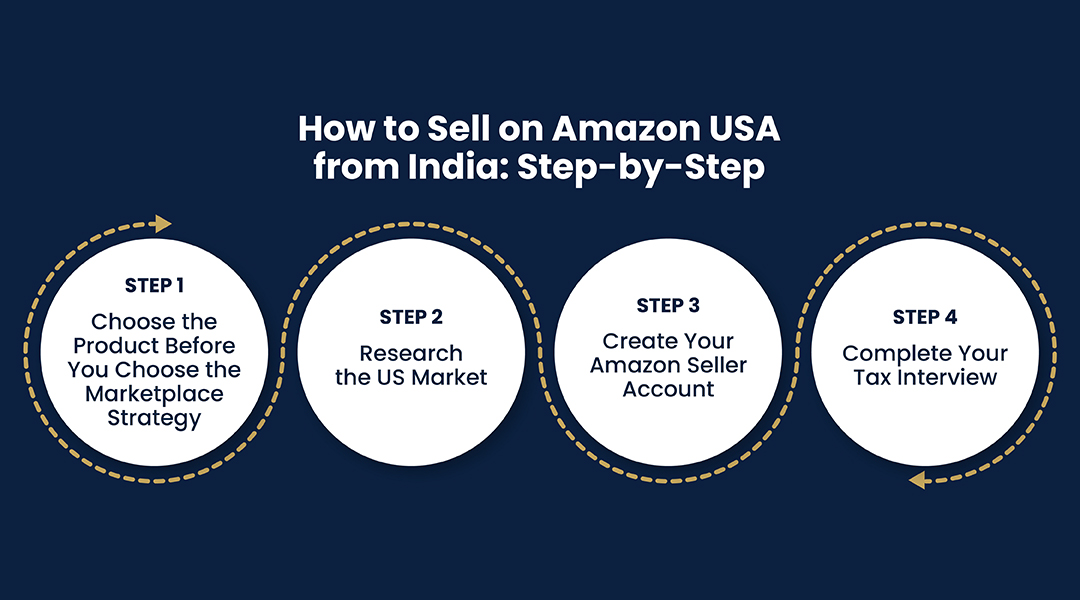
Step 1: Choose the Product Before You Choose the Marketplace Strategy
The first question isn’t:
“How do I open an Amazon USA account?”
It’s:
“What product can I profitably sell to an American customer?”
A product that costs ₹500 to manufacture in India isn’t automatically profitable when sold for $25 in the US.
You need to account for:
- Manufacturing
- Packaging
- Domestic transportation
- International freight
- Duties and import costs
- Amazon selling fees
- FBA or fulfillment
- Advertising
- Returns
- Currency conversion
- Compliance
- Storage
A useful product-selection test
Score your potential product on:
| Factor |
Question |
| Demand |
Are US customers actually looking for it? |
| Competition |
How difficult will it be to compete? |
| Margin |
Does the selling price support your costs? |
| Weight |
Is it economical to ship? |
| Size |
Will fulfillment/storage become expensive? |
| Fragility |
How likely is it to arrive damaged? |
| Compliance |
Are there additional US requirements? |
| Differentiation |
Why would someone choose your product? |
| Returns |
Is the product likely to be returned? |
| Scalability |
Can you consistently manufacture/replenish it? |
Don’t choose a product simply because it is popular in India.
US demand is what matters.
Step 2: Research the US Market
Before manufacturing a large batch, research:
- Amazon search results
- Competitor pricing
- Review counts
- Customer complaints
- Product features
- Search terminology
- Ratings
- Product sizes
- Packaging
- Seasonal demand
Customer reviews can be particularly useful.
Don’t only read five-star reviews.
Read the one-, two- and three-star reviews.
They can reveal exactly what American shoppers dislike about existing products, which can become an opportunity for your product.
Step 3: Create Your Amazon Seller Account
Amazon’s current India-to-US process allows sellers to create a North America and Brazil unified account.
If you already have an Amazon selling account, you can use the Sell Globally dashboard to create the relevant North America account. If you are new to Amazon, Amazon provides a direct registration pathway for the North America and Brazil unified account.
During registration, you’ll provide information about yourself and your business.
Amazon may ask you to verify your identity using government identification and proof of residential address.
Once registered, configure your shipping, returns and tax settings before listing products.
Step 4: Complete Your Tax Interview
Amazon requires sellers to complete a tax interview as part of account configuration.
For foreign individuals, US tax documentation can involve forms such as Form W-8BEN, depending on the circumstances.
The IRS explains that Form W-8BEN is used by foreign individuals to establish their non-US status and, where applicable, claim treaty benefits or an exemption/reduction in withholding.
That does not mean every Indian seller has the same tax outcome.
Your obligations can depend on:
- Individual vs company status
- Where your business is established
- Where inventory is held
- US business activities
- Income type
- Tax treaties
- State-level requirements
- Your Indian tax position
For anything beyond the basic Amazon tax interview, speak to a qualified tax professional familiar with India-US cross-border commerce.
How Much Does It Cost to Sell on Amazon USA from India?
This is where many new sellers make their first major mistake.
They calculate:
Selling price – manufacturing cost = profit
It doesn’t work that way.
Your actual unit economics should look more like
Product cost
- Packaging
- India-side logistics
- International freight
- Duties/import costs
- Amazon selling fees
- FBA/fulfilment
- Storage
- Advertising
- Returns
- Payment/FX costs
= Total selling cost
Then:
US selling price − total selling cost = contribution before other business expenses
Amazon currently lists a Professional selling plan at $39.99 per month, in addition to selling fees. Referral fees vary by product category, and optional services such as FBA and advertising introduce additional costs.
Example
Imagine a product sells for $40.
Your approximate costs might look like this:
| Cost |
Example |
| Product |
$7 |
| Packaging |
$1 |
| Freight/import allocation |
$5 |
| Amazon fees |
$8 |
| Fulfilment |
$6 |
| Advertising |
$5 |
| Returns/other allocation |
$2 |
| Total |
$34 |
| Remaining contribution |
$6 |
These are illustrative numbers, not a forecast.
The point is simple:
A product can look highly profitable at the factory gate and still have a thin margin once it reaches a US customer.
Before ordering inventory, calculate your economics per unit.
Amazon FBA vs FBM: Which Is Better for Indian Sellers?
Once you have a product, you need to decide how orders will reach customers.
Fulfilment by Amazon (FBA)
With FBA, you send inventory into Amazon’s fulfillment network. Amazon handles major parts of storage, picking, packing, shipping, customer service and returns.
FBA can make sense when:
- Demand is reasonably predictable
- Your margins support fulfillment fees
- Customers expect fast delivery
- You want to scale without managing every order yourself
But FBA isn’t automatically the right answer for every product.
Fulfilled by Merchant (FBM)
With FBM, you or your fulfillment partner handle customer orders.
This can make sense for:
- Certain oversized products
- Lower-volume products
- Specialized products
- Products where FBA economics are unattractive
- Early-stage testing
A simple decision rule
Testing demand? Consider a lower-commitment fulfillment model.
Proven demand + healthy margins? FBA may become more attractive.
Oversized/specialized product? Compare FBA and FBM economics carefully.
The best fulfillment strategy is the one that makes sense for your product, volume and margins, not the one that sounds most convenient.
How to Ship Products from India to Amazon USA
Your supply chain doesn’t end when the product leaves your factory.
Think of it as
Manufacturer → Indian logistics → Export → International freight → US import → Warehouse/FBA → Customer
Depending on the product and fulfillment model, you may need to consider:
- HS classification
- Commercial invoice
- Packing list
- Export documentation
- Customs
- Duties
- Import requirements
- Product-specific compliance
- FBA shipment requirements
- Importer-of-record responsibilities
- US warehousing or 3PL arrangements
Air freight vs sea freight
Air freight
It usually makes more sense when speed is important or you’re moving smaller quantities.
Sea freight
Can become more economical for larger shipments but requires more planning and longer lead times.
Don’t optimize only for the cheapest freight quote.
A delayed shipment that leaves your Amazon listing out of stock can cost more than the freight savings.
Do Indian Sellers Need a US Warehouse?
Not necessarily for every business model.
The appropriate arrangement depends on whether you’re using:
- FBA
- FBM
- A US 3PL
- Direct cross-border fulfillment
- A hybrid model
For FBA, your inventory needs to enter Amazon’s fulfillment network according to Amazon’s requirements.
For merchant fulfillment, you need a reliable system for storing, packing, and shipping orders to US customers.
A US 3PL can sit between your Indian supply chain and Amazon, allowing inventory to be inspected, stored, prepared and forwarded when needed.
For a fi rst shipment, compare the cost of:
India → Amazon directly
against:
India → US 3PL → Amazon
The second route can add a cost layer but may provide greater operational flexibility.
How Do Indian Sellers Receive Amazon USA Payments?
You don’t automatically need a US bank account just to receive Amazon sales proceeds.
Amazon provides international sellers with payout options that can allow proceeds to be transferred to a bank account in the seller’s home country. The exact options available depend on the seller’s account and configuration.
When comparing payout methods, don’t look only at the advertised transaction fee.
Also compare:
- Exchange rate
- FX margin
- Transfer fees
- Settlement time
- Documentation
- Reconciliation
- Export/remittance reporting requirements
At small volumes, the difference may seem insignificant.
At scale, it can materially affect your margins.
Taxes and Compliance for Indian Sellers
There are three different questions here:
1. What does Amazon require?
This includes your seller account information and tax interview.
2. What does India require?
This can include export, GST, income tax, banking, and foreign remittance considerations.
3. What does the US require?
This can include federal tax, state-level requirements, import requirements and product-specific regulations.
These should not be treated as one single “Amazon tax.”
What about GST?
GST treatment depends on your business structure and transaction flow. Export-related GST treatment can differ from ordinary domestic sales, so Indian sellers should assess their specific arrangement with a tax professional.
What about US sales tax?
US sales tax is primarily state-based, and marketplace facilitator laws mean Amazon may collect and remit sales tax on qualifying transactions in many jurisdictions.
That doesn’t necessarily mean your broader US tax and registration obligations disappear.
What about W-8BEN?
For a foreign individual, Form W-8BEN may be relevant to establish foreign status and, where applicable, claim treaty benefits or reduced withholding.
The correct form and treatment depend on the taxpayer and circumstances.
Do not copy another Amazon seller’s tax structure simply because it worked for them.
How to Optimize Your Amazon Listing for US Customers
Getting onto Amazon USA is only half the job.
You still have to convince an American shopper to click, understand and buy your product.
This is where localization matters more than translation.
For example, an Indian seller may describe a product using terminology that makes perfect sense in India but doesn’t match how US customers search.
Your listing should reflect:
- US search behavior
- Natural American English
- Customer pain points
- Appropriate measurements
- Relevant product terminology
- Clear benefits
- Lifestyle context
- Product use cases
Don’t simply translate an Indian listing into English.
Rewrite it for the person buying in America.
For a deeper look at titles, bullets, backend search terms, imagery, A+ Content and Amazon’s evolving AI shopping experience, see Gracia Marcom’s Amazon listing optimization guide.
Amazon SEO in 2026: Think Beyond Keywords
Amazon search is not just about inserting the same keyword into your title repeatedly.
A strong listing should help a customer understand:
What is this?
Who is it for?
Why should I buy it?
How is it different?
How do I use it?
Does it solve my problem?
That becomes even more important as AI-powered shopping experiences increasingly interpret natural-language questions and product information.
The practical approach is simple:
Write for the customer’s question first and the algorithm second.
Keyword research still matters.
But keyword stuffing is not a strategy.
How to Market an Indian Brand to US Customers
Amazon can give you access to customers.
It doesn’t automatically build your brand.
For an Indian brand entering the US, there are potentially two overlapping audiences:
The Indian diaspora
These customers may already understand:
- Indian ingredients
- Cultural references
- Regional products
- Traditional craftsmanship
- Indian food terminology
- Heritage stories
The broader American market
These customers may need more context.
They may be buying the same product because it is:
- Convenient
- Better designed
- Healthier
- More sustainable
- Beautiful
- Functional
- Unique
- Better suited to their lifestyle
That’s why cultural authenticity and US-market localization need to work together.
You don’t have to remove the Indian identity from a product.
You have to make that identity understandable and relevant to the customer you’re trying to reach.
For a broader international market-entry perspective, see our guide to international market-entry strategies.
And if diaspora audiences are an important part of your strategy, explore NRI and diaspora marketing.
Should You Advertise Outside Amazon?
For some brands, yes.
Amazon PPC can help generate initial visibility and collect useful search and conversion data.
But your long-term strategy doesn’t necessarily have to stop at Amazon.
Depending on the product, you could also consider:
- Instagram
- YouTube
- Influencer marketing
- Google Ads
- PR
- Content marketing
- Email
- Community marketing
- Diaspora publications
- Creator partnerships
The objective is to build demand that isn’t entirely dependent on one marketplace.
If someone discovers your brand on Instagram, reads a review in a publication, watches a creator demonstrate the product and then buys it on Amazon, Amazon becomes the transaction layer inside a larger marketing ecosystem.
Common Mistakes Indian Sellers Make on Amazon USA
1. Assuming a US LLC is mandatory
A US LLC can be useful for some business models, but Amazon does not make incorporation universally mandatory.
2. Choosing a product because it is cheap to manufacture
Manufacturing cost is only one part of your unit economics.
3. Ignoring US compliance
Product requirements vary by category. Don’t assume that something legally sold in India can automatically be sold in the same form in the US.
4. Ordering too much inventory
Validate demand before committing significant working capital.
5. Forgetting advertising costs
Your product needs to remain profitable after customer acquisition.
6. Translating instead of localizing
The language your Indian customers use may not be the language your US customers search.
7. Ignoring returns
Returns can materially change your margins.
8. Treating Amazon registration as the whole business
An approved Seller Central account doesn’t guarantee demand.
9. Copying another seller’s tax structure
Your business may have a different legal and operational setup.
10. Trying to compete only on price
Indian manufacturing advantages can help, but a strong US brand needs a reason to exist beyond being cheaper.
Amazon USA Readiness Checklist for Indian Sellers
Before you invest heavily in inventory, ask:
- Have I validated demand in the US?
- Have I researched my competitors?
- Do I know my target US selling price?
- Have I calculated my landed cost?
- Have I included Amazon fees?
- Have I included advertising?
- Have I considered returns?
- Have I checked product-specific US compliance?
- Do I understand my Indian export requirements?
- Have I reviewed my tax position?
- Have I chosen FBA, FBM or another fulfillment model?
- Do I have a replenishment plan?
- Is my listing written for American shoppers?
- Is my packaging suitable for the US market?
- Do I have enough working capital?
- Do I have a marketing strategy beyond simply listing the product?
If you cannot answer several of these questions, don’t rush into a large inventory order.
Fix the business model first.
Is Selling on Amazon USA from India Worth It in 2026?
It can be, but it isn’t automatically profitable.
The opportunity is attractive because the US is a large consumer market and Amazon gives international sellers an established marketplace infrastructure.
But the old formula of
Cheap Indian manufacturing + expensive US selling price = easy profit
is too simplistic.
The stronger model is
Real US demand + differentiated product + efficient supply chain + healthy unit economics + compliant operations + strong listing + effective marketing = scalable opportunity
For Indian brands, manufacturing, craftsmanship, sourcing and cultural heritage can all become competitive advantages.But they become valuable only when they solve a problem or create a reason for a US customer to buy.
How Gracia Marcom Can Help Indian Brands Sell and Grow on Amazon USA
Getting started on Amazon and growing on Amazon are two different challenges.
Once the account exists, brands still have to deal with:
- Seller Central management
- Listing optimization
- Keyword research
- PPC
- Brand Registry
- FBA and inventory
- Storefronts
- A+ Content
- Account health
- Performance analysis
- Ongoing optimization
That’s where specialist support can make sense.
Gracia Marcom provides Amazon marketing services across account management, PPC and advertising, listing optimization, brand registry and protection, FBA and inventory support, storefronts, and A+ content. We work across multiple Amazon marketplaces, including Amazon.com.
Our approach isn’t limited to getting a product listed. The objective is to understand the category, the competition, the customer and the brand, then build the Amazon strategy around those factors.
For Indian brands entering the US, there’s another layer to consider: how the brand communicates with both diaspora and mainstream American audiences.
That is where Amazon marketing and broader market-entry strategy can work together.
Selling on Amazon gets your product into the marketplace. Positioning, content, advertising and customer understanding help determine whether it grows.
If you’re an Indian brand considering Amazon USA, explore Gracia Marcom’s Amazon Marketing Services to see how we can support account management, PPC, listings, Brand Registry, FBA/inventory and brand-building.
Final Takeaway
Yes, you can sell on Amazon USA from India in 2026.
You don’t need to begin by assuming that you must create a US LLC, rent an American office or build a complicated corporate structure.
You need to begin with something much more important:
A product that Americans actually want to buy at a price that leaves you enough margin to build a business.
From there, the process becomes manageable:
Research the product → understand US demand → set up your Amazon account → handle tax/export requirements → choose fulfillment → ship inventory → build a US-focused listing → advertise → measure → optimize → scale.
And if you’re building an Indian brand for the US market, don’t think of Amazon as the entire strategy.
Think of it as one part of your market-entry system.
Your product gets you into the marketplace. Your positioning, customer understanding and marketing give people a reason to stay.
FAQs
Can I sell on Amazon USA from India?
Yes. Indian sellers can use Amazon’s Global Selling infrastructure to sell to US customers through Amazon.com.
Can I sell on Amazon USA without a US LLC?
Yes, a US LLC is not universally required to register as an Amazon seller. Whether forming a US entity makes sense is a separate legal, tax and business-structure decision.
Do I need a US bank account to sell on Amazon USA?
Not necessarily. Amazon provides international sellers with payout options that can allow proceeds to be transferred to a bank account in the seller’s home country, subject to the available account configuration.
Can I use Amazon FBA from India?
Yes. Indian sellers can send inventory into Amazon’s US fulfillment network, provided the shipment and products meet applicable Amazon and import requirements.
What documents are required to sell on Amazon USA from India?
Depending on your circumstances, you may need identification, address information, business details, bank information and tax information for Amazon, along with Indian export documentation such as IEC and relevant tax/business records.
Do I need GST to sell on Amazon USA from India?
GST requirements depend on your business and transaction structure. Don’t assume that every seller has the same GST obligations.
What is IEC and do I need it for Amazon USA?
IEC stands for Importer-Exporter Code. It is an important part of India’s export framework and is generally relevant to businesses undertaking import/export activity, subject to applicable exemptions.
How much money do I need to start selling on Amazon USA?
There is no universal minimum. Your starting capital will depend on the product, minimum order quantity, shipping method, fulfillment model, advertising budget and working capital requirements.
Is FBA better than FBM?
Not necessarily. FBA can be attractive for products with proven demand and sufficient margins, while FBM may make sense for certain products, testing phases or fulfilment models.
What products from India can sell well in the USA?
Potential opportunities can exist across areas such as home and kitchen, textiles, apparel, crafts, beauty, jewellery, food and lifestyle products. But category popularity alone isn’t enough. Validate demand, competition, compliance and unit economics before choosing a product.
How can I market my Indian product to US customers?
Start with US customer research and localization. Then combine Amazon SEO, PPC, strong product content and brand positioning with relevant external channels such as social media, creators, PR and diaspora marketing.