![]()
An Indian food brand can rank for high-intent keywords on Amazon U.S. by targeting the exact phrases shoppers type just before they buy, then using Amazon’s own click, cart, and purchase data to confirm that those phrases turn into orders.
Here is the part many brands miss. A keyword that brings clicks but no purchases is not high-intent for your brand. It only adds to your ad bill.
This guide shows you how to build a food-specific keyword list, score it by buying behavior instead of search volume, match each keyword to the right product, and prove what works before you scale. You do not need to be an SEO expert to follow it.
What Makes a Keyword “High-Intent” for an Indian Food Brand?
A high-intent keyword is a search phrase that shows the shopper is ready to buy. Strong Amazon U.S. marketing services start by finding these phrases first, because they bring orders, not just visits.
In food, intent hides in the details. Compare “Indian snacks” with “vegan Indian curry pouch.” The first shopper is browsing. The second has already chosen a cuisine, a diet, and a format. That shopper is much closer to buying.
Food purchases depend on six things: the dish or cuisine, the format, the dietary need, the occasion, the pack size, and the use case. When a search contains two or three of these, intent is usually high.
Generic Amazon keyword advice treats every product the same. Packaged food does not work that way.
How Do You Build a Keyword List That Fits Indian Food?
Use this simple structure: dish or cuisine + format + dietary need + occasion + pack size + use case. You do not need all six in every phrase. Mix them based on your product.
Here are three examples:
- “ready to eat paneer tikka masala” (dish + format)
- “vegan Indian curry pouch” (dietary need + cuisine + format)
- “Indian meal kit for camping” (cuisine + format + use case)
Build a list of a few dozen phrases this way. Then add ideas from Amazon’s search suggestions, competitor listings, and customer reviews. Brand Analytics, available to brands enrolled in Amazon Brand Registry, adds real query data on what shoppers search.
Keep every phrase tied to a product you actually sell. A phrase your product cannot deliver on sends clicks to a listing that cannot convert them.
How Do You Bridge Indian Dish Names and U.S. Shopper Language?
Indian dish names and everyday American search terms are often different. Your research needs two columns: heritage terms and shopper-language terms.
| Heritage term |
Shopper-language term |
| poha |
instant breakfast, flattened rice breakfast mix |
| khakhra |
crunchy snack, thin crispy flatbread |
| rajma |
kidney bean curry |
Diaspora shoppers often search by dish name. Shoppers outside the diaspora often search by the meal they need. Neither group is always right for your brand, so test both.
Check whether your listing appears when you search each phrase. Then run small ad tests and compare the results in Amazon’s query data. Keep the terms that bring purchases and drop the rest.
How Do You Prioritize Keywords Without Relying on Search Volume?
Search volume shows how many people search. It does not show how many people buy. A phrase with 2,000 searches and steady orders can be worth more to you than one with 50,000 searches and none.
Use this formula to score each phrase:
Query opportunity = Demand × Relevance × Conversion potential × Ability to win share
- Demand: how many shoppers search for it.
- Relevance: how closely it matches your product.
- Conversion potential: how likely a user is to buy.
- Ability to win share: how realistic it is to compete, given your reviews, price, and rivals.
Rate each factor from 1 to 5 and multiply the scores. “Indian food” might score 5 × 2 × 2 × 1 = 20. “Vegan Indian curry pouch” might score 3 × 5 × 4 × 3 = 180.
The second phrase wins easily, even though fewer people search for it.
What Does Amazon’s Query Funnel Tell You About Each Keyword?
Amazon’s Search Query Performance report shows impressions, clicks, cart adds, and purchases for each search query. It also shows your brand’s share at each step. Brand-registered sellers can find it in Brand Analytics.
Add these columns to your scorecard: query volume, click share, cart-add share, purchase share, conversion rate, and whether the query is branded or non-branded. Branded queries show existing awareness. Non-branded queries show room to grow.
Many Indian food brands have a good product and steady traffic, yet few buyers. The funnel shows where shoppers drop off:
| What you see |
What it usually means |
What to fix |
| Few impressions |
Amazon does not connect your listing to the phrase |
Title, bullets, backend terms |
| Impressions, few clicks |
The result is not appealing |
Main image, title, price |
| Clicks, few cart adds |
The offer is not convincing |
Pack size, price, benefits |
| Cart adds, few purchases |
Something blocks the final step |
Reviews, delivery, price, product fit |
More ranking will not fix weak conversion. This table helps you tell a visibility problem from an offer problem.
How To Map Each Keyword to the Right ASIN?
An ASIN is the unique product ID Amazon gives each listing. Many food brands sell several flavors, spice levels, and multipacks. If those listings chase the same phrases, they compete against each other.
The fix is simple: give each ASIN one primary search intent. Decide which product owns searches such as “single-serve,” “variety pack,” “mild,” “spicy,” “vegan,” or “ready-to-eat.”
For example, your single pouch of paneer tikka masala owns “ready to eat paneer tikka masala.” Your six-pack variety box owns “Indian ready meals variety pack.”
Then place each phrase where it counts:
- Title: the main intent.
- Bullets: supporting phrases.
- A+ content: context and comparison.
- Backend search terms: synonyms and variations.
Use each phrase naturally. Amazon’s guidance favors relevant terms and discourages repetition, so keyword stuffing will not help.
How Can PPC Help You Prove a Keyword Before You Commit to It?
Think of PPC as a testing lab for your keywords. Paid ads give you quick data on which phrases bring buyers, so you do not have to wait months for organic ranking to tell you.
Follow this process:
- Run exact-match ads on your highest-scoring phrases.
- Track conversion rate and purchase share for each one.
- Replace weak terms and raise bids on strong ones. Amazon’s advertising guidance supports using search-term performance this way.
- Move proven phrases into your title, bullets, A+ content, and backend fields.
This order matters. It shows you which phrases deserve a permanent place in your listing. A phrase that fails in ads is unlikely to perform better once it sits in your title.
How Do You Write Listings That AI Shopping Assistants Can Understand?
Amazon’s AI shopping assistant, now called Alexa for Shopping, increasingly draws on listing details, reviews, and Q&A to answer shopper questions. It does not rely only on exact keyword matches.
So write for questions, not just keywords. Build your listing around direct answers:
- What is it?
- Who is it for?
- When should they use it?
- Why choose it?
- How is it different?
Then answer the questions food shoppers actually ask, in your bullets, A+ modules, and Q&A: “Is this spicy?” “How many servings?” “Is it vegan?” “Does it need refrigeration?” “Is it ready in two minutes?” A simple comparison chart in A+ content also helps shoppers see how your pack differs from others.
Next, mine reviews for your products and your competitors’ products. Look for repeated words about taste, heat level, authenticity, convenience, portion size, and preparation. Use that language only when it is true for your product. Customers’ own words often match how future shoppers search.
Which Food Trust Details Help You Convert Shoppers?
Packaged food buyers need confidence before they click “Buy.” Make these details easy to find and easy to verify:
- Ingredients and allergen declarations
- Nutrition facts and serving size
- Shelf life, storage, and preparation instructions
- Certifications such as USDA Organic, Non-GMO, Vegan, Gluten-Free, Kosher, or Halal
Only claim what you can prove. Avoid unsupported words such as “healthy,” “authentic,” or “preservative-free.” Follow FDA labeling rules, including allergen declarations. Sesame, common in Indian cooking, is now one of the nine major allergens the U.S. requires food labels to declare. Rules change, so check with a food-regulatory expert before you publish claims.
These details also help AI assistants answer shopper questions correctly. Clear information removes doubt, and less doubt means more purchases.
How Do You Track and Defend the Keywords You Win?
Rank alone can mislead you. Track share instead. Each week, review your top queries by click share, cart-add share, and purchase share, and note the week-over-week change.
Report “share won” and “share lost” rather than only keyword position. If your purchase share drops on a key phrase, look for a new competitor, a price change, a review problem, or an out-of-stock product.
This habit protects your best keywords and shows you where to invest next.
What Is the Best Way to Start?
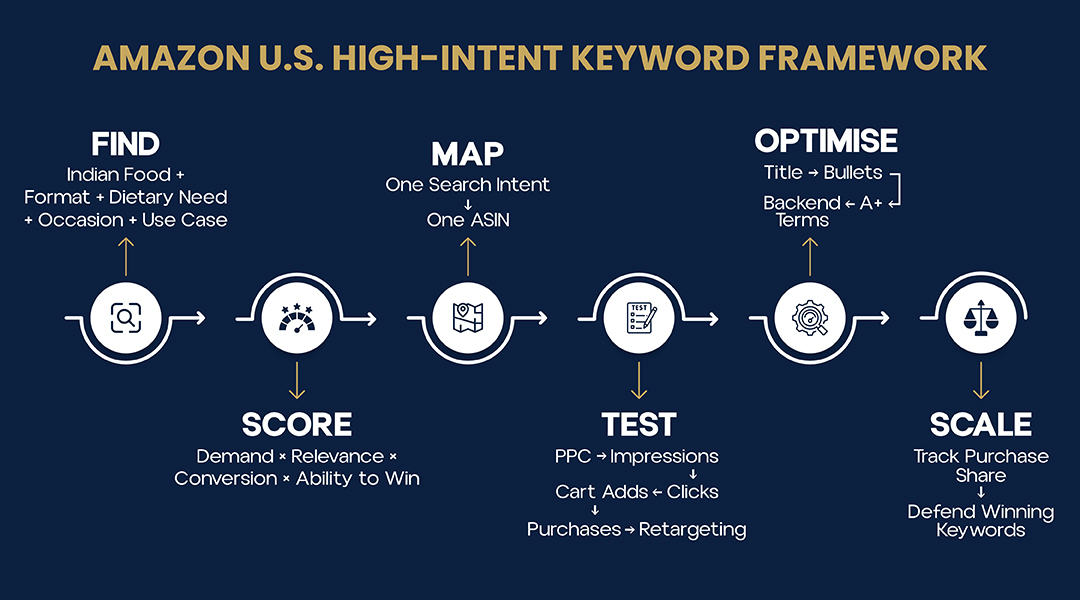
Ranking for high-intent keywords on Amazon U.S. comes down to one loop.
Build food-specific phrases, score them by buying behavior, map each to one ASIN, prove them with PPC and query data, and defend your share.
Start small. Pick ten phrases, score them with the formula above, and check their funnel this week.
If you would rather have a team handle it, Gracia Marcom has spent over 15 years marketing to the Indian diaspora. Our Amazon U.S. marketing services are built for Indian food brands that want profitable growth, not just more traffic.
Apply for Your Amazon U.S. Profitability Engine™ Strategy Call, and let’s find the keywords that can make your brand profitable.