
![]()
Amazon Global Selling from India lets you list products on Amazon’s international stores, ship them abroad, and receive payment in rupees. In 2026, Amazon U.S. remains the strongest place to start.
Amazon says Indian exporters have crossed $20 billion in cumulative exports through the program. Most of them began with one product and one spreadsheet. The sellers who stayed profitable worked out their numbers before the first shipment left India.
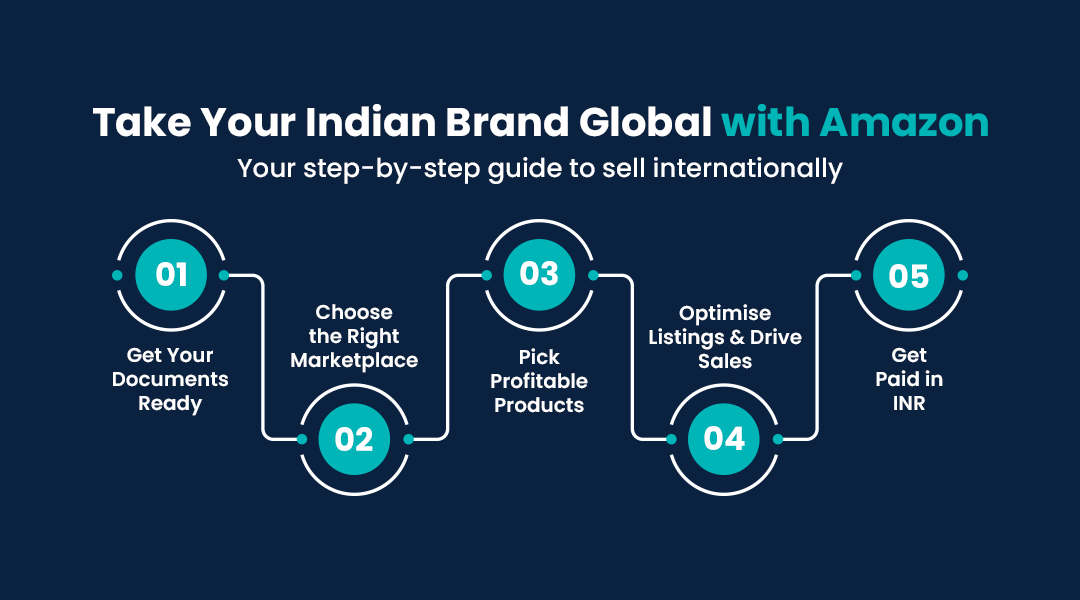
This guide walks you through that process, one step at a time.
Fees, duties, and rules change often, so confirm current figures in Seller Central before you act.
What is Amazon Global Selling, and is it right for your business?
Amazon Global Selling is Amazon’s export program for Indian businesses. You register once, list products on 18+ Amazon marketplaces, and reach shoppers in each country. You can ship every order yourself, or send stock to Amazon’s warehouses abroad.
It suits you if:
- Your product already sells well in India.
- Your margins can absorb freight, duty, and advertising.
- You can fund stock and ads for about at least three months before profits arrive.
It is a poor fit for thin-margin products or one-off experiments. Cross-border costs add up fast, so profit comes from planning, not from listing alone.
Which documents and registrations do you need before you start?
Get these ready before you open a seller account:
- PAN and GST registration: Export sales are zero-rated under GST, but you still need to be registered.
- Import Export Code (IEC): A 10-digit code from DGFT. Exporters must have it.
- AD Code: A code from your bank, registered with customs, so your shipping bills can be filed.
- Letter of Undertaking (LUT): A yearly filing on the GST portal. It lets you export without paying IGST upfront.
- Bank account, ID, and card: A business bank account, government ID, and an internationally enabled credit or debit card.
- Product certificates: Needed for some categories. Food, for example, must follow U.S. FDA rules.
Complete them in this order: GST, IEC, bank and AD Code, then LUT. Registration itself can take about 15 minutes when your papers are ready. Amazon’s verification may take longer, so apply early.
Which Amazon marketplace should you pick first?
Start with one marketplace. For most Indian brands, that is Amazon U.S. It has the largest customer base, and Amazon reports that the U.S. is still the top market for Indian exporters despite tariff uncertainty. For food and lifestyle brands, Indian-American shoppers are often an easy first audience.
| Marketplace |
Why choose it |
Watch out for |
| U.S. |
Biggest demand, strong diaspora buyers |
Tariffs, FDA rules, heavy competition |
| UAE |
Close to India, large Indian community |
Smaller market, VAT registration |
| UK and EU |
Strong for home, beauty, and food |
VAT, local labeling rules |
| Canada, Australia, Japan |
Less crowded niches |
Smaller volumes, language and rules |
Before you commit, search your product on Amazon U.S. Note the top sellers’ prices and review counts. Pick the market where buyers already want your product, then add others later.
Which products should you sell first?
Start with light, durable products that can carry freight, duty, and fees. Amazon says India’s export strengths include health and personal care, beauty, toys, home goods, apparel, and furniture. Food, spices, and tea also suit diaspora shoppers, though they need extra compliance checks.
Very cheap items often struggle to stay profitable once freight and fees are added. Test any idea in the landed-margin sheet later in this guide before you order stock.
How do you create listings that sell to U.S. shoppers?
If your product is already in Amazon’s catalog, match its ASIN. If not, create a new listing. The Build International Listings (BIL) tool can copy your catalog from one marketplace to another.
Then localize. Translation is not enough. Use words American shoppers search for, measurements in ounces and inches, and clear images that show size and use. Write a title that says what the product is, who it is for, and why it is better.
Food and supplement sellers must also follow FDA labeling rules. Check ingredients, nutrition panels, and claims before you print packs.
Should you use FBA, MFN, or Amazon SEND?
Use FBA when you can fund bulk stock. Use MFN when you only want to test demand with small volumes.
| Option |
How it works |
Best for |
Main risk |
| FBA |
You ship stock in bulk to Amazon’s U.S. warehouses. Amazon packs, delivers, and handles returns. |
Proven products, Prime eligibility |
Upfront freight, duty, and storage fees |
| MFN |
You ship each order from India. |
Small demand tests |
Slow delivery, high per-parcel cost |
| Amazon SEND |
Amazon’s cross-border shipping service. It moves FBA stock from India to Amazon warehouses with pickup and customs support. |
FBA sellers without a freight partner |
Lanes and rates change, so check current options |
Here is a simple rule. Add up the per-unit cost of each route. For FBA, that is the FBA fee, storage, and your bulk freight. For MFN, that is the courier cost per parcel. Choose the route that leaves the better margin at your expected volume.
Most brands that scale choose FBA, because fast delivery and the Prime badge usually help sales. FBA also needs an importer of record, which we cover below.
How do you know if a product will be profitable?
Work out your landed margin before you ship. Landed margin is what you keep per unit after every cost between your factory and the customer’s door.
Here is a worked example for a snack pack that sells for $25 on Amazon U.S. through FBA. The numbers are illustrative, so replace them with your own quotes.
| Cost per unit |
Amount |
| Product and packaging |
$5.00 |
| India-to-U.S. freight |
$1.50 |
| Import duty (assumed 15% on $5 value) |
$0.75 |
| Customs and importer-of-record fees |
$0.40 |
| Amazon referral fee (15%) |
$3.75 |
| FBA fulfillment fee (assumed) |
$4.00 |
| Storage |
$0.20 |
| Advertising (10% of price) |
$2.50 |
| Returns and damages (3%) |
$0.75 |
| Currency conversion (assumed 2%) |
$0.50 |
| Total cost |
$19.35 |
| Profit per unit |
$5.65 (about 23%) |
Now find the break-even price. Fixed costs are $11.85 per unit, and about 30% of the price goes to percentage-based costs. Divide $11.85 by 0.70 and you get about $17. Below that price, every sale loses money.
Run the same sheet for MFN by swapping in your courier cost per parcel. Then compare the two margins side by side.
What tax, customs, and importer-of-record rules apply?
On the India side, exports are zero-rated under GST. File your LUT, issue proper export invoices, and match every shipping bill with your records. This keeps refunds and incentives such as RoDTEP and duty drawback available where they apply.
On the U.S. side, every shipment needs an importer of record (IOR). This is the party that files the customs entry and pays duty. FBA sellers usually appoint an IOR and a customs broker, or use SEND, which includes customs support. Amazon normally collects U.S. sales tax for you.
Tariffs deserve extra care because the rules have changed several times this year. As of early October 2026, most Indian-origin goods pay the normal U.S. duty for their product code, plus an extra 10% Section 301 duty in force since July 24, 2026. Some products are exempt, and steel and other covered goods follow separate rules. Confirm your HTS code and the current rate before you set a price.
How do you get paid in rupees?
Amazon typically pays out every 14 days to your Indian bank account. You have two main routes:
- Amazon Currency Converter for Sellers (ACCS): Amazon converts dollars to rupees for you. It is simple, but it charges a conversion margin.
- A cross-border payment provider: You receive dollars in a U.S. collection account and convert them at a time and rate you choose.
Compare the final rupees you receive, not the advertised fee. A small margin on every payout adds up quickly.
Keep a FIRA or FIRC and an e-BRC for each payment. They prove that export money reached India, and you need them for incentives and tax records.
How do you launch and grow in your first 90 days?
Getting listed is only half the job. Getting found is the other half, and that is where Amazon U.S. marketing services help, covering listing optimization, PPC ad management, and brand content such as A+ pages. Whether you hire help or run it in-house, follow a simple plan:
- Days 1 to 30: Launch one hero product. Fix the title, images, and A+ content. Ship a small first batch and start basic auto ads.
- Days 31 to 60: Review search-term data. Move winning keywords into manual campaigns and pause the ones that waste money. Track ACoS, which is ad spend as a share of ad sales.
- Days 61 to 90: Restock winners before they sell out. Check storage fees. Add a second product only after the first one is profitable.
What mistakes do Indian sellers make most often?
These errors cost sellers the most:
- Pricing from the India price list instead of the landed cost.
- Using the wrong HS or HTS code, which causes customs delays.
- Ignoring currency losses on payouts.
- Sending too much stock too soon.
- Skipping FDA labeling checks on food and consumables.
- Treating the U.S. like India, relying on ads alone and ignoring reviews, A+ content, and brand story.
What do Indian sellers ask most about Amazon Global Selling?
How much does it cost to start?
The Professional plan costs $39.99 a month on Amazon U.S. On top of that, you pay referral fees (most categories charge about 15%), FBA fees, freight, duty, and ads. Amazon sometimes runs discounts for new Indian sellers, so check current offers.
Do I need a company to sell?
No. A sole proprietor can sell if they hold GST, an IEC, and a business bank account.
How long does it take to go live?
Registration can take about 15 minutes with documents ready. Verification and your first shipment take longer, so plan for weeks, not days.
Is Amazon U.S. still worth it with tariffs?
It can be, if your landed-margin sheet still shows a profit after duty. If it does not, raise the price or cut costs. Do not ship at a loss.
Ready to start selling on Amazon U.S.?
Amazon Global Selling rewards sellers who plan. Get your documents right, start with one marketplace, price from landed cost, choose your fulfillment route with care, and protect your payouts. Do that, and the numbers hold up.
You do not have to do it alone. Gracia Marcom has spent over 15 years marketing to the Indian diaspora in the U.S. Our Diaspora Seller Blueprint helps Indian brands grow on Amazon U.S. with listings, ads, and brand content built for diaspora shoppers.