![]()
What Is Amazon ACOS and Why Is It So Critical in 2026?
Reducing Advertising Cost of Sales (ACoS) on Amazon means optimizing your ad campaigns so you spend less ad money for every dollar of revenue generated. It is calculated by dividing your total ad spend by your total ad sales and multiplying by 100. For U.S. sellers navigating competitive categories, leveraging specialized Amazon advertising services helps turn high ad spend into predictable profit. By trimming wasted clicks, refining keyword intent, and upgrading listing conversion rates, brands can bring down their ACoS while scaling revenue on Amazon Seller Central.
Why Is Your Amazon ACOS Skyrocketing in the U.S. Marketplace?
If you’ve noticed your ad bills creeping higher over the past few seasons, you are definitely not alone. The U.S. Amazon marketplace has become more crowded than ever, driving up average Cost-Per-Click (CPC) rates across almost every category. Working alongside a dedicated Amazon marketing agency allows brands to navigate these rising costs with targeted bidding strategies instead of guessing. Rather than throwing more budget at high CPC keywords, smart sellers focus on intent-driven structure, precise negative keyword pruning, and on-page customer experience to keep profitability healthy.
What Are the Primary Causes of High ACOS for Amazon Sellers?
Before jumping into solutions, it helps to understand why ad spend gets out of hand in the first place. High ACoS is rarely a random accident; it’s usually a signal that something in your sales funnel needs attention.
Here are the most common culprits holding back account performance:
- Broad and Uncontrolled Auto Campaigns: Running automatic campaigns without migrating converting keywords into manual exact-match campaigns leads to overpaying for discovery terms.
- Ignoring Negative Keywords: Allowing non-converting customer search terms to drain $5, $10, or $20 a day without setting negative match rules.
- Weak Product Listings: Sending paid traffic to a detail page with poor hero images, sparse bullet points, or missing A+ content.
- Bidding Aggressively on Low-Margin SKUs: Treating high-margin products and low-margin accessories with the same blanket ad strategy.
- Mixing Branded and Generic Keywords: Lumping your own brand name searches (which naturally have a low 5–10% ACoS) with competitive generic terms, hiding where budget is actually leaking.
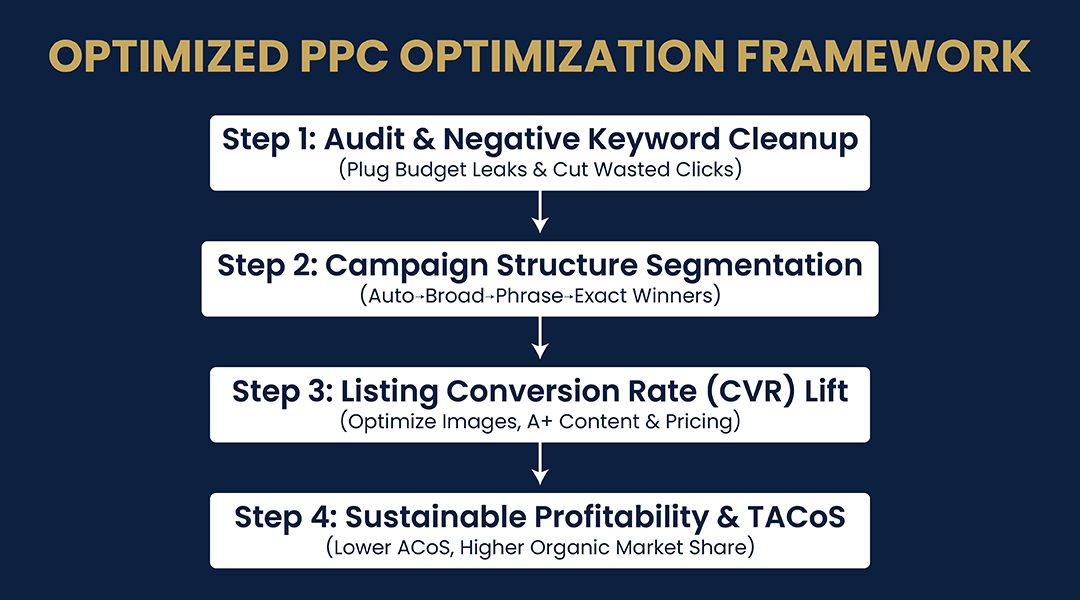
How Can You Eliminate Wasted Ad Spend with Aggressive Negative Keywords?
The single fastest way to drop your ACoS within 7 to 14 days is to stop paying for clicks that will never convert. Think of negative keywords as patching holes in a bucket before pouring in more water.
What Is the 15-Click Rule for Harvesting Negatives?
Pull your search term report from Amazon Seller Central for the last 30 days. Filter for any search term that has accumulated 15 or more clicks with zero sales. Every single one of these terms is actively draining your margin.
For example, if you sell premium stainless steel water bottles and your automatic campaign triggered ads for “cheap plastic water bottle,” that query might collect 50 clicks without a single order. Adding “plastic” and “cheap” as negative phrase match keywords instantly stops that drain, saving hundreds of dollars every month that can be reinvested into terms that actually sell.
How Does Restructuring Your Amazon Campaigns Drop ACOS Fast?
Many sellers make the mistake of dumping dozens of keywords into a single campaign. When everything is mixed, Amazon gives most of the budget to high-volume keywords, whether they are profitable or not.
What Is the Ideal Campaign Structure for Intent Control?
To regain control over your ad spend, organize your Amazon PPC account into clear, single-purpose campaigns based on match types and intent:
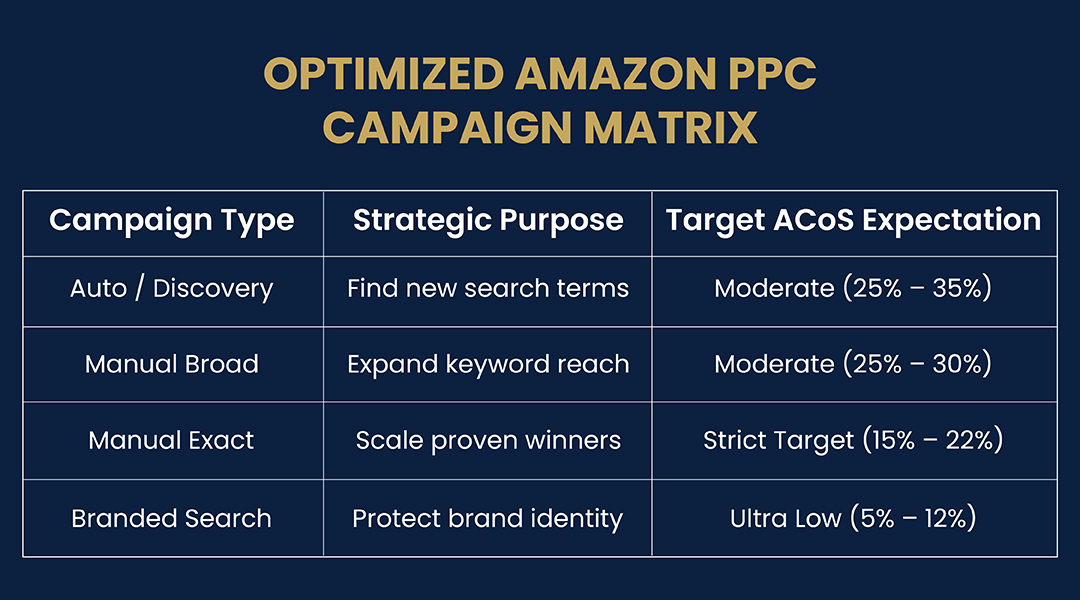
When a search term converts consistently in your Auto or Broad campaign, move it into a dedicated manual exact match campaign where you can set a precise bid. Then, add that exact keyword as a negative in your source Auto campaign so you don’t end up bidding against yourself.
Why Is Listing Conversion Rate the Hidden Key to Lowering ACOS?
Here is an open secret in Amazon marketing: ACoS is a math ratio, and your listing’s conversion rate (CVR) drives the bottom half of that equation.
If your product listing converts at 8%, you need roughly 12 clicks to make a sale. But if you improve your listing to convert at 16%, you only need 6 clicks to make that same sale. You just cut your ACoS in half without changing a single keyword bid!
What Listing Elements Directly Impact Conversion Rates?
- Hero Image Clarity: Does your main image stand out on mobile screens against competitors in search results?
- A+ Content & Visual Comparison Charts: Are you clearly communicating your product’s unique value and answering top buyer objections?
- Review Velocity and Ratings: Are you maintaining at least a 4.2-star rating with consistent recent customer feedback?
- Clear Bullet Points: Do your bullets highlight benefits first rather than just listing technical features?
How Do Placement Multipliers and Dayparting Optimize Your Ad Spend?
Not all ad placements on Amazon are created equal. In most product categories, ads appearing at the top of search (first page) convert 2x to 3x better than ads shown on product detail pages or in the rest of the search results.
How Should You Adjust Placement Bids for Maximum Efficiency?
Instead of raising your base bids across the board, lower your default bid and apply a strategic placement multiplier (e.g., +30% to +50%) specifically for Top of Search. This ensures your ad budget goes toward prime visual real estate where conversion likelihood is highest.
What Role Does Dayparting Play in Ad Efficiency?
Review your hourly performance data in Seller Central or via API analytics. Most retail categories experience 2-3 off-peak hours (often late at night) where conversion rates dip significantly. Using dayparting rules to lower bids during low-converting hours prevents wasted impressions while conserving budget for peak shopping hours.
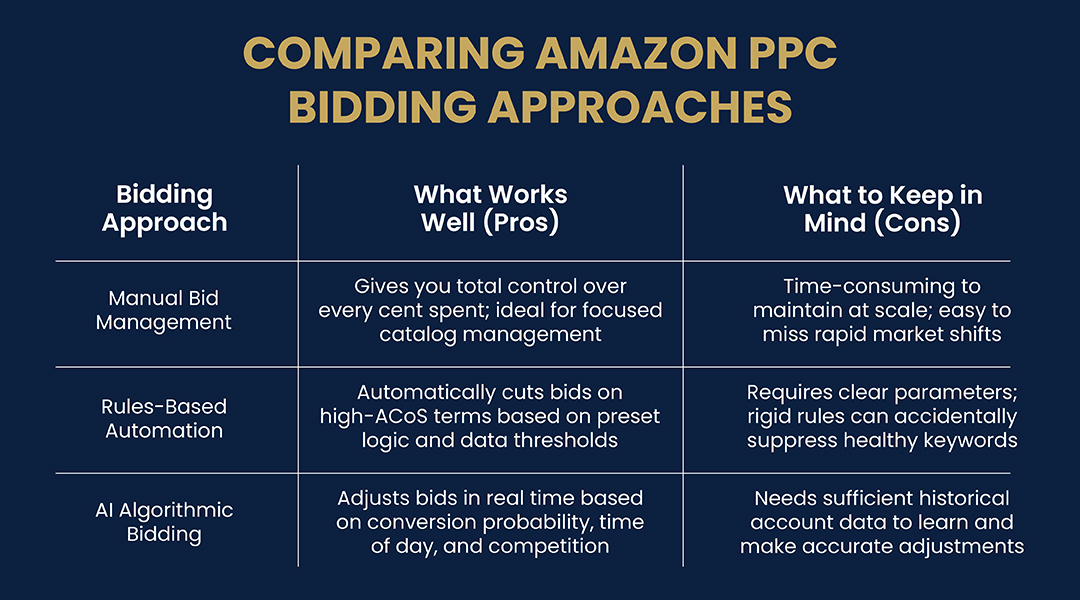
What Are the Pros and Cons of Automated Bidding vs. Manual PPC Control?
Deciding how to manage campaign bids depends on your SKU count, internal resources, and account maturity.
What Real-World Case Study Proves This 2026 ACOS Strategy Works?
To see how these principles work in practice, consider a U.S.-based home goods brand that was struggling with a 38% ACoS on Amazon Seller Central USA.
What Steps Were Taken to Turn Performance Around?
- Negative Keyword Sweep: Harvested 30 days of search term reports and added over 60 zero-conversion search terms as exact negatives, saving $450 in the first week.
- Campaign Restructuring: Separated branded search terms into their own campaign and created dedicated Exact Match campaigns for the top 10 converting keywords.
- Listing Optimization: Upgraded main lifestyle images and added a comparison module in A+ Content, lifting the product’s conversion rate from 9.4% to 14.8%.
What Were the Final Results?
Within 45 days, the brand’s overall ACoS dropped from 38% to 21%, while total ad revenue increased by 27%. More importantly, as organic ranking improved due to higher conversion efficiency, their total ACoS (TACoS) improved by 4.5 percentage points, adding direct profit to their bottom line.
How Do You Choose an Amazon Marketing Agency Near You for U.S. Growth?
Scaling an Amazon business in today’s U.S. marketplace takes more than quick bid tweaks; it requires a complete strategy spanning catalog SEO, PPC management, creative design, and margin analysis. Partnering with a skilled NRI marketing agency near you gives cross-border and domestic brands the hands-on expertise needed to cut ad waste, protect margins, and achieve sustainable long-term growth.
How Can Gracia Marcom Help You Lower ACOS and Scale Profitably on Amazon?
At Gracia Marcom, we specialize in driving profitable growth for brands selling on Amazon and global online marketplaces. From granular PPC restructuring and negative keyword management to conversion-driven A+ content design and overall account management, our team helps you turn high ad spend into predictable ROI.
Ready to lower your ACoS and unlock profitable growth on Amazon?
Contact Gracia Marcom today to request your comprehensive Amazon PPC audit and strategy consultation!
FAQs
What Is Considered a “Good” ACoS Target on Amazon in 2026?
A “good” ACoS completely depends on your product’s profit margins and campaign goals. If your profit margin before advertising is 30%, any ACoS below 30% means you are turning an immediate profit on paid traffic. Generally, a target ACoS between 15% and 25% is ideal for scaling mature SKUs, while a higher target is acceptable during new product launches. Managing these shifting targets across large product catalogs often requires a dedicated full-funnel strategy, which is where working with a specialized team like Gracia Marcom ensures every ad dollar serves a specific financial goal.
What Is Break-Even ACoS, and How Do You Calculate It?
Your break-even ACoS is the exact point where your advertising costs equal your net profit margin before ad spend, meaning you break perfectly even on an ad sale. It is calculated as: (Net Profit per Unit / Selling Price) × 100. Knowing this number gives you a clear baseline; bidding above it sacrifices profit, while bidding below it builds net revenue. Partnering with seasoned marketplace strategists at Gracia Marcom helps ensure these math models and automated bidding rules are configured accurately from day one.
How Long Does It Take to See Results After Optimizing Amazon PPC?
With aggressive negative keyword pruning and campaign restructuring, initial ad waste can drop within 7 to 14 days. However, achieving a sustained, long-term reduction in overall ACoS typically takes 30 to 45 days. This allows Amazon’s algorithm time to process listing updates, recalibrate placement efficiencies, and reward higher conversion rates. Having an execution partner like Gracia Marcom handle continuous search term harvesting and A+ Content optimization accelerates this timeline significantly.
Why Should You Track TACoS (Total ACoS) Instead of Just PPC ACoS?
Focusing solely on PPC ACoS gives an incomplete picture of your store’s financial health. Total Advertising Cost of Sales (TACoS) measures your total ad spend against your total revenue (organic sales + ad sales). A falling or stable TACoS, even if PPC ACoS fluctuates slightly, proves that your advertising strategy is successfully driving organic keyword rank. Gracia Marcom aligns PPC campaigns with organic SEO, creative branding, and storefront optimization to reliably drive down your TACoS across competitive international marketplaces.