
![]()
Expanding business into a foreign market is one of the most exciting, and most challenging, decisions a brand can make. The potential upside is enormous: new revenue streams, a larger customer base, reduced dependence on a single economy, and a stronger brand reputation. But the risks are equally real. Brands that enter foreign markets without a clear, culturally informed strategy often find that what worked at home simply doesn’t translate.
This guide breaks down the key strategies that actually move the needle when advertising a business abroad, from understanding your target audience at a cultural level, to choosing the right media mix, to measuring what’s working. Whether you’re a mid-sized or huge Indian company eyeing the US diaspora market, or an international brand looking to connect with communities in Southeast Asia or the Gulf, these principles apply.
1. Start With Deep Market Research – Not Assumptions
The single biggest mistake brands make when entering a foreign market is assuming their existing audience insights will carry over. They won’t, not fully. Consumer behaviour, purchasing motivations, trust signals, and even colour symbolism can differ significantly from one country to another.
Before you spend a rupee or a dollar on advertising, do a thorough market research. Which includes:
- Studying the demographic and psychographic profile of your target audience in that specific geography.
- Identifying your local competitors, who’s already serving this market, what they charge, and how they position themselves.
- Understanding the regulatory and legal environment, advertising standards, data privacy laws, and industry-specific restrictions that differ from your home country.
- Conducting qualitative research: interviews, focus groups, or surveys with real members of your target community.
For brands targeting the Indian diaspora specifically, NRIs (Non-Resident Indians) settled in the USA, UK, Gulf, Singapore, or other hubs, this research layer is especially critical. NRI communities are not monolithic. A Gujarati family settled in New Jersey has different lifestyle patterns, media consumption habits, and emotional triggers than a Punjabi professional in Toronto or a Malayali nurse in Dubai. Treating them as one segment leads to generic, forgettable advertising, often resulting in unsuccessful investment.
2. Build Cultural Intelligence Into Your Campaigns
Cultural intelligence is the ability to understand, respect, and communicate effectively across cultural differences. It’s the foundation of everything.
This goes beyond simply translating your copy into the local language (though that matters too). Cultural intelligence in advertising means:
Using the right cultural references
Festivals, values, family structures, food, humour, and aspirations are deeply cultural. A campaign referencing cricket, chai, and the joint family structure will resonate very differently with an Indian-origin audience than a generic “aspirational lifestyle” ad. Authentic cultural references create instant emotional connection. Forced or inaccurate ones create distance, or worse, offend.
Respecting visual and aesthetic sensibilities
Colours, visual hierarchies, and imagery carry different meanings across cultures. In many South Asian communities, bright, celebratory visuals signal auspiciousness. In Japanese markets, clean minimalism often outperforms cluttered designs. Know what your target audience finds visually compelling and trustworthy.
Tone and communication style
Some cultures respond to direct, benefit-led messaging. Others prefer a narrative, relationship-first approach. In many diaspora communities, advertising that acknowledges the immigrant experience, the pride, the nostalgia, the dual identity, can be extraordinarily powerful, because it makes people feel seen in a way that mainstream advertising rarely does.
It is recommended to work with an experienced agency that has community networks, long-term relationships, well-aware about diaspora audience, interests and purchase triggers.
3. Choose the Right Media Channels for Your Market
There’s no universal answer to where you should advertise. The right media mix depends on your audience’s age, geography, income level, and media habits, and these vary enormously across foreign markets.
Digital & Social Media
For most markets, digital advertising is non-negotiable. Facebook, Instagram, YouTube, and Google remain the dominant platforms in North America, Europe, and much of Southeast Asia. However, the specific formats and content styles that perform well differ by market. In the US, short-form video (Reels, YouTube Shorts) has overtaken static posts in engagement. In the Gulf, WhatsApp remains a critical community communication channel that savvy brands are learning to leverage.
Don’t neglect diaspora-specific digital communities, online groups, forums, and cultural pages that aggregate your target audience. These are often under-utilised by brands and can deliver highly targeted reach at relatively low cost.
Community Events & On-Ground Activations
For diaspora marketing in particular, physical presence at community events is often the most trust-building form of advertising available. Events like cultural festivals, national day parades, Diwali melas, Holi events, or community galas bring your target audience together in one place with high emotional investment. Brands that show up consistently at these events, not just as advertisers but as genuine community supporters, earn a depth of brand loyalty that digital alone cannot replicate.
Events like the India Day Parade in New York City, the world’s largest celebration of Indian independence outside India, attract hundreds of thousands of attendees and generate massive media reach across television, digital, and print. For Indian brands in real estate, financial services, FMCG, education, and healthcare targeting NRI audiences, presence at such events is an extremely high-value investment.
PR & Media Partnerships
Earned media, editorial coverage, community newspaper features, radio spots on diaspora-focused stations, carries enormous credibility with immigrant communities, who often have high trust in community media that understands their experience. A well-placed feature in a respected Indian-American publication, or an interview on a community radio station, can outperform paid advertising in terms of audience trust.
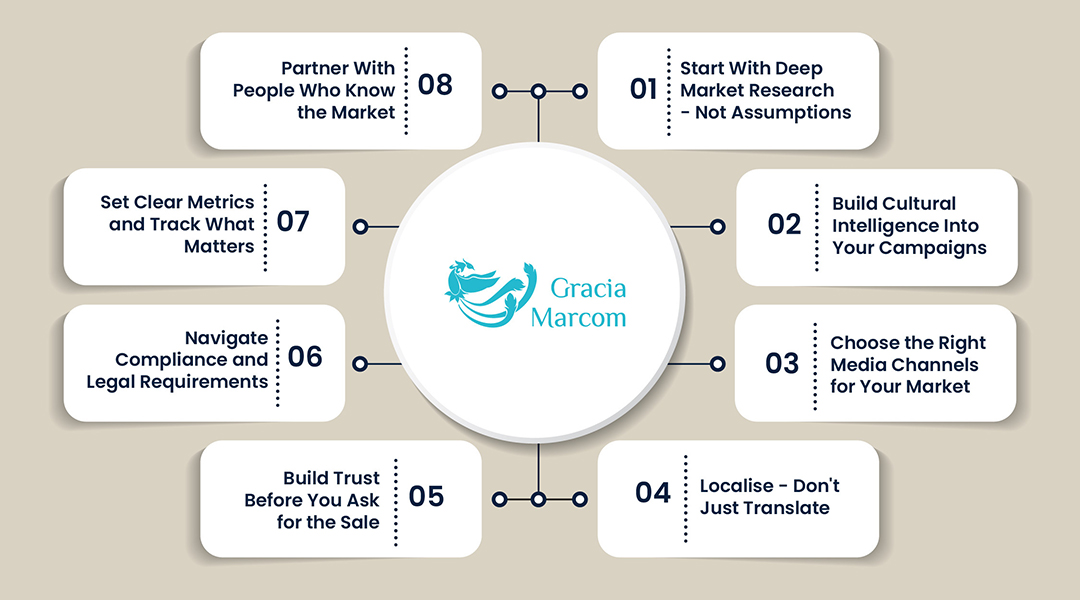
4. Localise – Don’t Just Translate
Localisation is the process of adapting your content to fit the cultural, linguistic, and contextual needs of a specific market. Translation is just one part of it.
True localisation for foreign market advertising involves:
- Rewriting copy from scratch in the target language, rather than directly translating from English, idiomatic expressions rarely survive literal translation.
- Adapting your value proposition to reflect what matters most to that specific audience. A real estate brand, for instance, might emphasise investment potential and NRI tax benefits for an NRI audience, rather than the generic “dream home” narrative it uses domestically.
- Using locally relevant social proof – testimonials from customers your audience can identify with, endorsements from community figures they respect, and case studies set in their world.
- Adapting your pricing communication, offer structures, and payment options to local norms and financial behaviours.
- Ensuring your post-ad experience works – landing pages, contact options, and customer service must actually be able to serve customers in that market. Poor post-click experience is one of the most common and costly failure points in cross-border advertising.
5. Build Trust Before You Ask for the Sale
In most foreign markets, and especially in diaspora communities, where word-of-mouth and community trust are powerful forces, advertising works best as a long game. Brands that show up, contribute genuinely, and build familiarity over time consistently outperform those that run isolated campaigns and expect immediate returns.
Practically, this means:
Consistency over spikes
A sustained presence across community events, social media, and local media over 12-18 months will typically deliver better ROI than a high-spend blitz campaign followed by silence. Your audience needs to see you repeatedly before they trust you enough to act.
Community investment, not just community targeting
Sponsoring a local cultural event, supporting a community cause, or partnering with a respected local organisation signals that your brand genuinely cares about the community, not just its spending power. This distinction is noticed, and it matters enormously to diaspora audiences who are, quite naturally, alert to brands that treat them purely as a market segment.
Influencer and community ambassador relationships
In many diaspora markets, trusted community voices, bloggers, YouTubers, community leaders, or respected professionals, carry significant influence. Authentic partnerships with the right voices can dramatically accelerate brand trust in a new market. The emphasis here is on authenticity: audiences can spot sponsored content that feels forced, and it can damage credibility rather than build it.
6. Navigate Compliance and Legal Requirements
This is often overlooked in the excitement of market entry, but it’s absolutely essential. Every country has its own advertising standards, consumer protection laws, data privacy regulations, and industry-specific restrictions.
Key areas to check before advertising in any foreign market:
- Advertising standards: What claims are permitted? What requires substantiation? Are there restrictions on comparative advertising?
- Financial and real estate advertising: These sectors often face additional regulatory scrutiny, particularly for overseas investment-related communications directed at diaspora audiences.
- Platform-specific policies: Meta, Google, and other platforms have their own ad policies that sometimes go beyond local legal requirements.
- Foreign exchange and remittance rules: For Indian brands marketing to NRIs, understanding RBI guidelines on foreign investment and FEMA compliance is essential.
Working with a local legal advisor or an agency with genuine expertise in your target market is not an optional extra, it’s how you avoid costly mistakes that can set a market entry back by months or years.
7. Set Clear Metrics and Track What Matters
Entering a foreign market is a significant investment, and you need a clear framework for evaluating what’s working. The specific metrics will depend on your campaign objectives, but a healthy foreign market advertising strategy typically tracks across three horizons:
Short-term (0-3 months)
Reach, impressions, click-through rates, cost per lead, and event attendance figures. These tell you whether your message is reaching the right people and generating initial interest.
Medium-term (3-12 months)
Lead quality, conversion rate, customer acquisition cost, and brand search volume in the target market. These tell you whether your advertising is building genuine pipelines.
Long-term (12+ months)
Brand recall, community sentiment, customer lifetime value, and referral rates. In diaspora markets especially, word-of-mouth referrals within the community are a strong signal of brand trust, and one of the most valuable outcomes of a well-executed foreign market strategy.
Regular reporting against these metrics, and the willingness to adjust strategy based on what the data shows, is what separates brands that build lasting foreign market presence from those that try once, see limited results, and pull back.
8. Partner With People Who Know the Market
Finally, and perhaps most importantly, foreign market advertising is not a DIY exercise. The cost of getting it wrong (wasted budget, damaged brand perception, missed windows of opportunity) far exceeds the cost of working with the right partners from the start.
What to look for in a foreign market advertising partner:
- Genuine community presence and relationships – not just claimed expertise, but actual on-the-ground experience and trust within the communities you’re targeting.
- A verifiable track record – in your target market, with case studies and results you can actually review.
- Cultural fluency across the full campaign lifecycle – from strategic insight and creative development through to media placement, event execution, and performance reporting.
- Honest counsel – the right partner will push back on assumptions that won’t hold in the local market, and give you honest advice even when it’s not what you want to hear.
The right agency partner doesn’t just execute your brief. They help you refine it, challenge your assumptions when necessary, and bring local insight that you simply cannot replicate from a head office thousands of miles away.

In Summary: What It Really Takes
Advertising your business into a foreign market successfully requires more than a translated brochure and a boosted social media post. It requires genuine market understanding, cultural intelligence, consistent presence, legal compliance, and the patience to build trust before expecting returns.
The brands that succeed in foreign markets, particularly in diaspora communities, are the ones that show up authentically, invest in real relationships, and commit to the long game.
If you are ready to transcend into the international market
Connect with Gracia Marcom NOW
It is a purpose-driven integrated marketing agency, with over 13 years of experience helping brands connect with Indian communities across the USA. The agency specialises in NRI and diaspora marketing, 360° integrated campaigns, cultural event management, digital marketing, and PR.
FAQs
How do I actually start advertising my business in foreign markets?
The first step isn’t ads, it’s understanding the market you’re entering. Who are you selling to? What do they care about? How do they make decisions? Once you have clarity on that, you can build campaigns that feel relevant to them. Most brands fail because they try to copy-paste what worked in India into a completely different market.
What’s the most effective way to reach Indian diaspora customers abroad?
There’s no single approach that works for all NRIs. A Gujarati family in the US and a working professional in Dubai think very differently. The brands that do well are the ones that tap into cultural context, local communities, and trusted platforms. Digital ads help, but real impact usually comes when you combine them with community presence and relatable messaging.
Why do businesses struggle when entering international markets?
In most cases, it comes down to assumptions. Brands assume their messaging, pricing, or positioning will work the same way everywhere. It doesn’t. Small things like tone, visuals, or even trust signals can completely change how people respond. Without adapting to the local mindset, even strong brands see poor results.
Is translating ads enough for international marketing?
Not really. Translation changes the language, but not the meaning behind it. What you actually need is localisation, where the message is rewritten to fit how people in that market think and respond. That includes everything from visuals to offers to the way you communicate value.
How long does it usually take to see results in a new market?
It’s rarely immediate. You might start seeing engagement or leads in the first few months, but real traction, like consistent conversions and brand recall, takes time. In most foreign markets, especially diaspora communities, trust builds slowly. The brands that stay consistent are the ones that eventually win.